A summer conversation with Dia Huizinga about women who made history.
by DANNY VAN ZUIJLEN

“When I talk about how things used to be, they hang on my every word”
A summer conversation with Dia Huizinga about women who
made history.
This summer, I’m talking to people who not only study history but have also lived through it themselves.
Dia Huizinga is one such person. Like me, she writes on Substack, Dia’s Life.
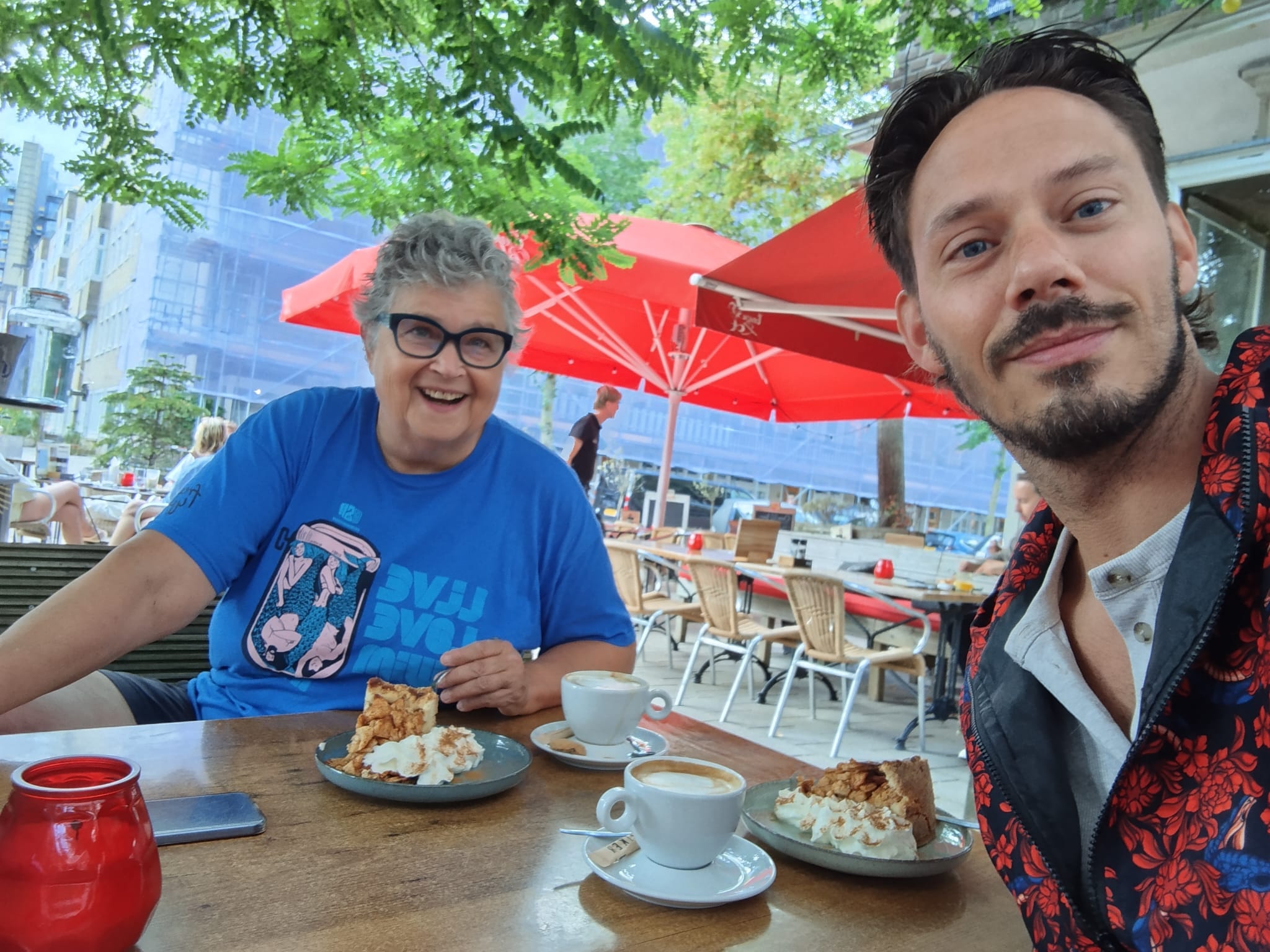
While enjoying a generous slice of apple pie with whipped cream, we sit on a terrace in sunny Amsterdam-Zuid and talk about the past and the present —but as soon as the first name is mentioned, memories start tumbling out one after another.
Dia speaks enthusiastically. The story of that one photographer leads to a memory of a feminist journalist, which in turn leads to a magazine, a squatted women’s house, and a dinner at someone’s home.
She’s brimming with enthusiastic stories. But what do you expect? Dia has been through a lot. Meanwhile, she notes that women who were obvious role models for her generation are often completely unknown to younger people.
“I notice that more and more often,” she says, eyeing a huge slice of apple pie eagerly. “Then I mention someone from another generation and they look at me: never heard of her.”
“Is that a bad thing?” I ask.
“It’s just that it was so recently. Take Marian Bakker. She took a lot of photos during the Gay Games, including of all the sports in which women competed. She photographed an incredible number of lesbian women. To me, she was the photographer of the lesbian movement in the 1980s and 1990s.”
A whole string of names follows. Meanwhile, she’s munching on the apple pie and the whipped cream.
Dia’s point is clear: behind every name lies another story, a network, or an initiative that risks disappearing if no one documents it.
This brings her to a large gathering for women about aging. It must have been in the ’90s. Hundreds of women were in attendance.
“It was a wild, wild gathering,” Dia says. “The question was: what are we going to do as we get older? At one point, someone shouted that we should start a magazine, too.”
And did that happen?
“Yes. It was called *De Leesbril*. ( The reading glasses). It was for women of a certain age. I was on the editorial board, along with, among others, Robertine Romeny. The founder of *De Leesbril* was Annemarie Behrends, a very well-known woman in the lesbian scene because she was so outspoken; Nelleke Oepkes was there, and so was Tineke Sluyter.
According to Dia, it was printed at the “De Brandweervrouw” printing shop. That shop, run by women, was located in a squatted building. That, too, is one of those details that hides a whole history behind it: women who conceived, produced, printed, and distributed a magazine all on their own.
“We did it for two or three years. It came out almost every month. We also had a column called ‘Onder de pannen’ (Under the lids). That’s when we’d go to people’s homes for dinner.”
“What did you write about that?” I ask her.
“About what they cooked, how the food tasted, and of course about the people themselves. We also visited well-known women. That was just really fun.”
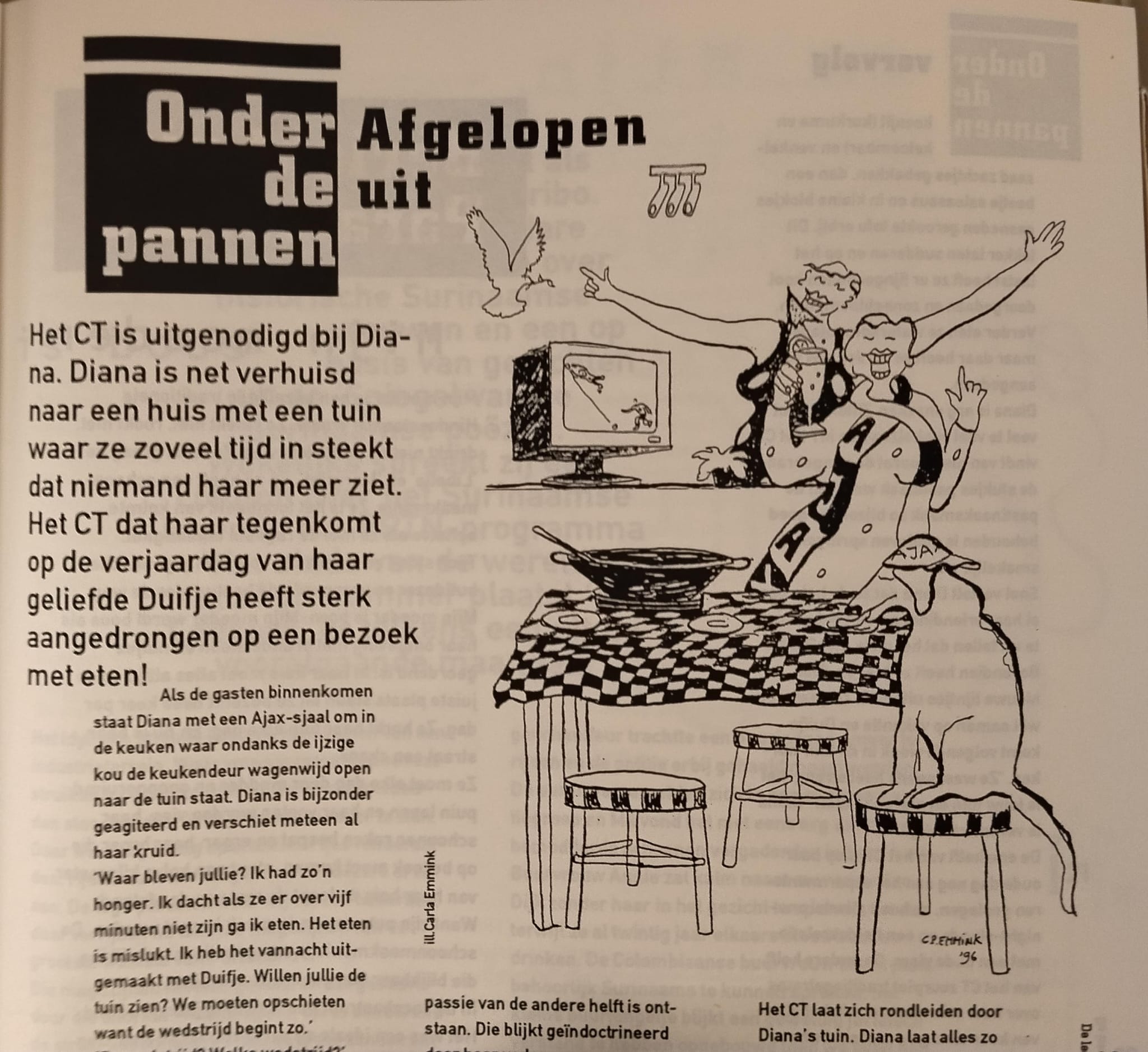
She tells the story casually, but it’s precisely these everyday memories that make the past tangible for me. The lesbian movement wasn’t just about meetings, demonstrations, and big names.
A plate of food at a kitchen table was part of it, too.
“Living as a lesbian was a choice,” she tells me, as she takes a bite of apple pie.
We start talking about the radical feminism of the free-spirited 1970s.
Dia remembers women who said that being a lesbian was a choice.
I ask if she understood what they meant by that.
“Not back then. I was maybe fourteen or fifteen and just thought it was weird. For me, it wasn’t a choice at all.”
We talk about it for a while. Later, she came to understand that statement differently.
“I think what they meant was: living as a lesbian is a choice. You can be a lesbian without living as a lesbian. A lot of women from my generation married a man. I never did that. I thought: I can’t do that.”
It’s a subtle distinction in words, but a major difference in meaning. Not choosing your feelings, but deciding to live openly according to them. For a generation of women, that often also meant choosing a community, women’s houses, their own magazines, and a life outside the expectations of family and society.
Dia is one of the women who experienced that world from the inside.
Yet she sees that much of it has barely been preserved in the archives.
That gets me thinking.
Who is collecting those stories today?
How do you pass that history on to a new generation?
Dia doesn’t have to think long about that.
Meanwhile, the apple pie is gone, and she pushes the empty plate away from her.
“That history simply has to be written. The history of the lesbian movement.”
But doesn’t it have to be collected first? I ask her.
“Collected—that’s a good idea.”
Do young people come to you for that? I want to know.
“Not really yet. I wouldn’t mind it at all. When I tell a story, I do notice that people are hanging on my every word. Maybe because I tell stories in an engaging way,” she says with a laugh, “or because young women really enjoy hearing what it was like. Because, actually, almost no one knows that anymore.”
The same goes for the history of major gay events. Dia talks about a party called “Miami Nightmare” in 1977 at the Concertgebouw, which some people at the time thought was too commercial. That’s why people from the movement organized an alternative program.
It was called “Nichtenherrie / Nachtmerrie.” (Faggots Ruckus) De Rooie Flikkers (The Red Faggots) organized it in response to what they saw as the overly bourgeois party at the Concertgebouw.
Is that the one you chose to go to back then?
“Yes. I had been invited to that big party, but when I realized how commercial it was, I went to the alternative one. That was a lot of fun.”
She looks back on it a bit more leniently now.
“When I think about it now, I wonder why we were so opposed to it.”
That naturally brings us to this year’s World Pride. Even now, there’s criticism about commercialization. Dia listens to it, but has little patience for easy grumbling.
“An old gay grumbler told me this week that he had to pay nine euros for a glass of rosé,” she says. “Of course, your first thought is: ‘Wow.’ But you’re not just paying for that drink. An event like that costs an enormous amount of money.”
And Dia should know. She’s been the organizer and founder of LoveSwim for years—an annual queer swimming event in the Amstel that draws hundreds of participants from all over the country—and in 2026, it celebrated its 10th anniversary edition.
“An orchestra, security, barriers, lifeguards, restrooms. Those restrooms there were spotless, there was toilet paper, and there were people stationed there. If the paper ran out, you’d get a new roll right away. All of that has to be paid for.”
She also points out the many volunteers who are at work during Pride.
Behind the visible parties and boats lies an organization that visitors often don’t see.
“People are quick to say that everyone wants to make money off it. But it also just costs a lot. Maybe people would complain less if they knew what it all costs.”
That statement is typical of her. She was once strongly opposed to a commercial gay party, but now defends the organizers of Pride Amsterdam against overly simplistic criticism. Not because she doesn’t question Nine euros for a glass of rosé at all, but because she knows from experience how much work goes into an event.
“Maybe we could organize an evening where we talk about what it was like,” she suggests.
I can picture it right away. Not a formal lecture with a string of dates, but a long table. Women who complement each other, contradict each other, and suddenly remember a name again. Stories about activism and growing older, but also about printing magazines, eating together, and the choice to live openly as a lesbian.
“Would you want to share your story there yourself?” I ask her.
Dia had actually already given the answer during our conversation. She wouldn’t mind it at all. According to her, there’s interest in it, too.
As soon as she starts talking, people hang on her every word.
Read more, in the
Department of Forgotten History